

What are the legal advantages and risks of an asset purchase versus a stock purchase?
The legal advantages and risk of an asset purchase versus a stock purchase depends on the type of business being purchased, the business model, and tax issues. Before learning the advantage and risks and of each type of purchase, it is important to know the difference between an asset sale and a stock sale.
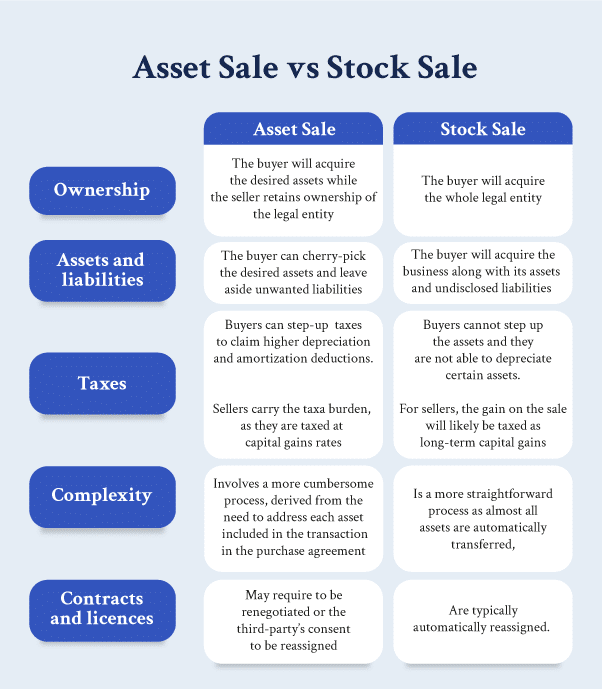
Asset Sale Versus Stock Sale
An asset sale is when the buyer purchases only the assets of the target business. A stock sale is when a buyer purchases the actual shares (if a corporation) or interest (if a LLC). When a buyer purchases the assets, the buyer typically creates its own entity and uses that entity to purchase the target’s assets. In this case, the buyer must clearly document the transfer of assets and employees to the new buyer’s entity. In a stock sale, the buyer can individually purchase the stock or interest of the target business or use an entity to purchase the stock and purchase as a “parent” company. In this case, all of the assets do not transfer.
Advantages Of An Asset Sale
Asset sales typically are ideal for smaller transactions because they tend to be more simple than stock sales. When a buyer purchases a seller’s assets only, the buyer does not inherit the liabilities of the target business. This simplifies due diligence and limits the buyer’s due diligence to the assets.
Other advantages include:
- Allowing the buyer to more easily pick and choose which assets are to be sold to the buyer
- The seller can keep part of its business and branding if the buyer does not want to sell the whole business
- The employees transfer to the buyer without employment liability issues that the seller may be responsible for such as wage claims or other employment violations.
- The buyer retains ownership of the balance sheet
In addition, buyers have a tax advantage because the buyer can claim the depreciation of assets.
Risks Of An Asset Sale
The risks of an asset sale center around losing the target businesses’ assets related to contracts, licensing, or credentialing. For example, in healthcare where insurance credentialing is tied to the legal entity itself, an asset sale can disrupt business operations for several months while the buyer obtains credentialing. Another example, in Florida specifically, is in the construction industry where a “qualifying agent” is required and tied to the business entity.
Another risk is potentially losing the brand and marketing of the target business because the buyer is operating under a different name. For some transactions, a buyer may want to operate under its own brand anyway, but where the value of the brand is tied to the seller’s target business, the parties should take great care to address this in the purchase agreement.
Lastly, if the target business’s business model relies heavily on third party contracts for its operations, the buyer may lose those contracts because those contracts are with the seller’s entity. The parties should either have those contracts assigned to the buyer, or consider a stock sale instead.
In summary, the risks of an asset sale are:
- The contracts of the target company not transferring to the buyer
- Disruption to the buyer’s operations upon transitions due to delay or inability to transfer credentialing or licensing in certain industries
- Buyer’s loss of intellectual property and branding, without proper planning
Advantages of a Stock Sale
The advantages of a stock sale center around the smooth transfer from the seller to the buyer because the buyer is buying the actual stock or interest of the target company. This means that licenses, contracts, and healthcare-related credentialing do not have to be transferred individually and the buyer simply steps into the shoes of the seller.
Risks of a Stock Sale
Stock sales are more common for transactions involving buyers backed by private equity, deals where the target business model is heavily dependent on contracts with third-parties, and in healthcare. Further, if the target company requires certain licenses or credentialing that is tied to the entity itself, an asset sale may be disruptive as the buyer must obtain the licenses or credentialing. This is where an asset sale is more appropriate.
For a buyer, because the buyer is purchasing the legal entity itself, the buyer inherits any legal liabilities such as potential lawsuits, compliance violations, and employment violations.
Generally, the risks of an stock sale are:
- The buyer inherits the target company’s liabilities
- As to the seller, the seller needs to understands that the buyer inherits the book’s balance sheet
- The purchase agreement and acquisition can be more complicated due to heightened due diligence
Is an Asset Sale or Stock Sale Better For You?
Whether an asset sale or a stock sale is better for you depends on the business model of the target business, the parties’ personal goals, and the size and nature of the deal. There is no “one size fits all” rule for whether a transaction should be an asset sale or a stock sale. With that said, it is important to decide early on, particularly during the LOI stage, the type of structure because there are certain assumptions going into the deal. For example, if the seller agrees to a stock sale but does not fully understand that the balance sheets, including lease security deposits, effectively belong to the buyer, then the seller will be unpleasantly surprised when the seller is not reimbursed for those items. Accordingly, the structure and specific negotiating points should be decided earlier than later.
Motiva Business Law provides business acquisitions services to entrepreneurs, startups, professionals, and companies throughout Florida. We assist clients in Tampa, St. Petersburg, Clearwater, Sarasota, Bradenton, Orlando, Lakeland, Brandon, Wesley Chapel, Zephyrhills, Lutz, Land O’ Lakes, Fort Myers, Naples, Miami, Fort Lauderdale, West Palm Beach, Jacksonville, Tallahassee, Gainesville, and communities throughout Hillsborough County, Pinellas County, Pasco County, Polk County, Manatee County, Sarasota County, Orange County, and beyond.
Motiva Business Law also serves clients throughout Illinois including Oak Brook, Burr Ridge, Naperville, Hinsdale, Lombard, Addison, Downers Grove, Oak Park, Darien, Chicago, Lisle, Westmont, Willowbrook, Clarendon Hills, and the Chicagoland Area.